
Pre production workflows are easier to understand by watching teams than by reading feature lists. One team runs on a shared drive. Another lives in a spreadsheet. Another starts with the script and builds outward. Another begins with the schedule. A connected team keeps the whole film in one place from the first reference to the final call sheet.
This article is for filmmakers comparing those options before the next project starts. Most pre production workflows fall into five patterns. The right one depends on where your film loses information.
What a pre production workflow is really for
A pre production workflow is the route a film takes from being an idea in one person's head to being a plan a crew can act on. It carries the references into the treatment, the treatment into the script, the script into the breakdown, the breakdown into the schedule, and the schedule into the day.
The question is not which team looks most organised. The question is which team loses the least at each handoff.
A workflow can be neat and still fragile. It can be messy and still hold together. What matters is whether the reason behind a decision survives long enough to reach the person who has to act on it.
The five patterns at a glance
| Workflow | Where the film lives | Best for | Where it breaks |
|---|---|---|---|
| The folder workflow | Documents, images, chat, and email | Very early ideas and tiny teams | Versions and missing context |
| The spreadsheet workflow | Breakdowns, schedules, and grids | Analytical producers and simple shoots | Manual updates and visual decisions |
| The script led workflow | The screenplay and its revisions | Writer led teams and development | The gap between words and logistics |
| The production management workflow | Schedules, call sheets, cast, and crew | Larger crews and formal shoots | The creative work that happened earlier |
| The connected workflow | One shared project from idea to set | Teams that want fewer handoffs | Teams that will not build shared habits |
None of these is wrong. Each one solves a different problem. The mistake is choosing a workflow for the production you wish you had instead of the one you are about to shoot.
The folder workflow
The folder workflow is where most films begin. A folder holds the treatment. Another holds references. A chat thread holds the decisions nobody wrote down. The shot list arrives as a document. The schedule arrives as a spreadsheet. The call sheet arrives as a PDF.
It works because everyone already understands it. There is nothing to learn and nothing to configure. For a two person team making a short film in one location, that may be enough.
The break comes with the second version. The treatment changes, but the folder still holds the old references. The shot list moves, but the schedule does not. The call sheet goes out, then the location changes, and now there are two truths moving toward the same morning.
The folder workflow is not a failure. It is a beginning. It becomes risky when the project has more people than one person's memory can hold. If that sounds familiar, read how to keep your whole film in one place.
The spreadsheet workflow
The spreadsheet workflow belongs to the producer who wants every scene, location, and person visible in one grid. It is fast, flexible, and honest about numbers. A good spreadsheet can carry a small film surprisingly far.
Its strength is control. You can make the columns match your production exactly. You can sort by location, filter by cast, count pages, and mark constraints. For one person holding the whole plan, it feels powerful.
Its weakness is that a film is not only rows. The spreadsheet knows that scene 9 needs a red coat, but it does not know why the coat is red. It knows scene 9 moved to Thursday, but not that the reference image, the shot size, and the location note all moved with it. Every change has to be copied into every place the change touches.
Use the spreadsheet workflow when the team is small, the plan is simple, and one person truly owns the sheet. Move on when the second person starts editing their own copy. If the schedule is the part under strain, build it from the breakdown rather than from a blank grid.
The script led workflow
The script led workflow starts where the story starts. The screenplay is the source, and everything else hangs off it. Revisions are tracked. Scenes are numbered. Comments live close to the lines they concern.
This works well when the film is still being written. It keeps the story coherent and gives writers, directors, and producers a shared place to argue about the film before the film becomes logistics.
The break comes when the words have to become a day. A scene heading is not a location plan. A line of action is not a prop list. A revision is not a call sheet. If the visual references, boards, breakdown, and schedule live somewhere else, the script becomes a very good centre with too many loose edges.
This workflow suits a writer led team in development. It needs help once the film enters prep. The handoff works best when the treatment, the storyboards, and the shot list can grow beside the script instead of being exported away from it.
The production management workflow
The production management workflow starts with the shoot. It is built around scenes, stripboards, schedules, cast, crew, call sheets, and permissions. It brings order to complexity.
This is the workflow a larger crew recognises. The AD can see the days. The production manager can see the people. Departments can see what each scene asks of them. The call sheet is not a heroic act of copy and paste. It is a document the system knows how to produce.
Its weakness is the beginning. If the tool only becomes relevant once the film is ready to schedule, the creative decisions that shaped the film may already be scattered across boards, documents, and chat. The production plan is organised, but it is separated from the thinking that created it.
This workflow suits a production with real logistics and a crew large enough to need formal control. It works best when the creative plan can flow into it rather than being summarised for it. The call sheet should arrive from the schedule, and the schedule should arrive from the scenes.
The connected workflow
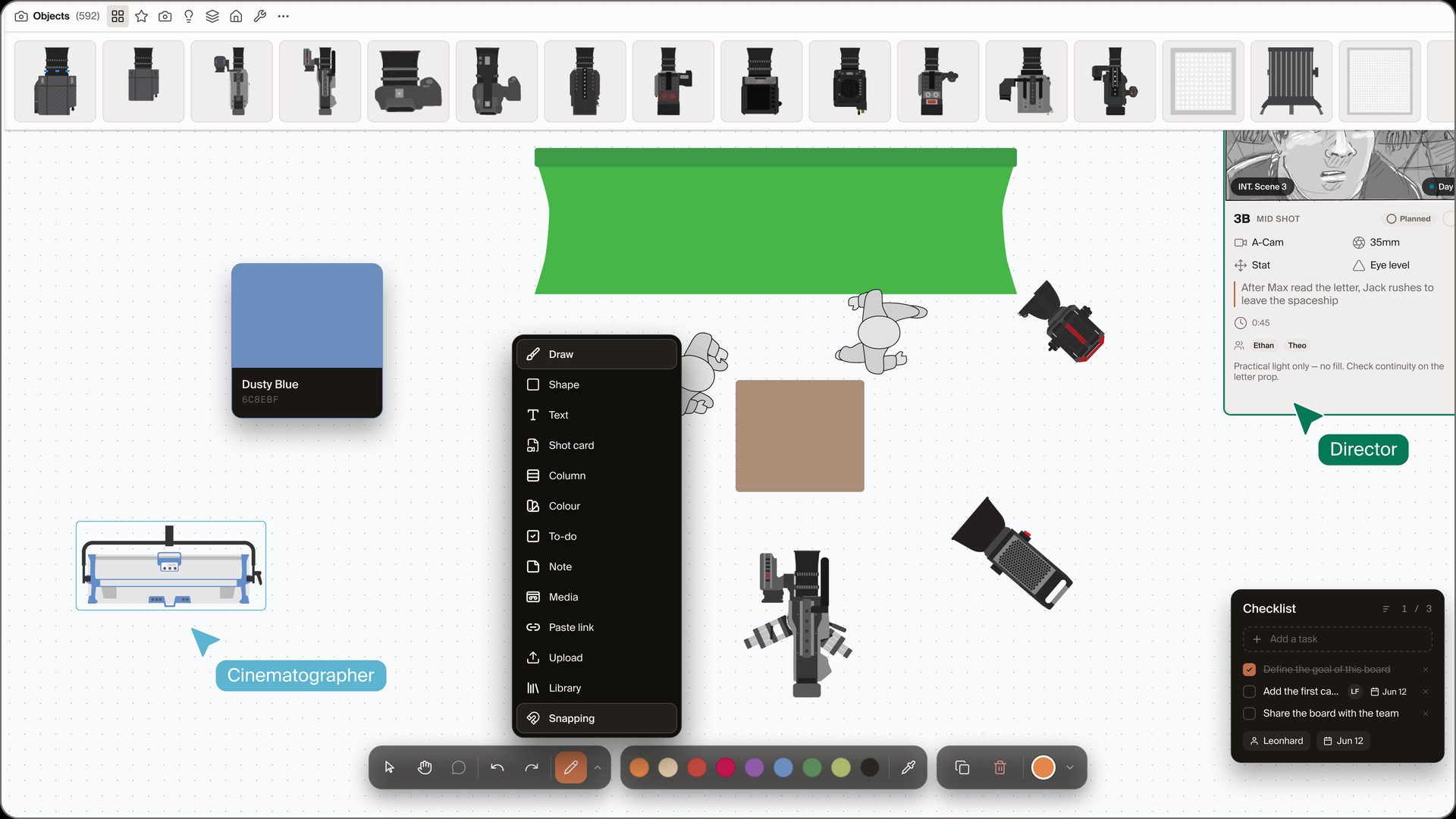
The connected workflow treats the film as one project from the first reference to the last call sheet. The moodboard, treatment, script, breakdown, shot list, schedule, cast, crew, and day all live in relation to each other.
This does not mean everyone works in the same view. It means everyone works from the same source. The director can stay close to the references and shots. The producer can see the days and the constraints. The cinematographer can see the visual plan. The crew can open the current call sheet without asking which version is right.
CineFlow is the creative space where filmmakers develop ideas into films, together. It is built around this connected workflow. Start with the idea and the references, shape them with the team, then carry the same project into the shot list, the schedule, and the call sheet. The plan stays live, the right people get the right access, and the day can still be exported to paper for the floor.
The connected workflow asks one thing in return: the team has to treat the shared project as the place where decisions live. A tool cannot create that habit on its own.
How to choose the workflow that fits your film
Start with the production, not the software.
Ask where the film currently lives. Ask who needs to change it. Ask what gets retyped when something moves. Ask which change caused the last confusion. Ask what must still be true when the crew is standing on set.
If you are two people and one location, keep the workflow light. If you are a writer and director still shaping the film, protect the development work. If you are a producer carrying cast, locations, and days, make the schedule do more of the remembering. If you are a crew with departments, put roles and permissions near the centre. If every handoff costs you a copy, a paste, and an apology, connect the workflow. And if you are weighing up tools, how to choose film production planning software walks through the tests that matter.
The right answer may change as the film grows. A folder can become a connected project. A script led process can grow into a schedule. What matters is that the next stage does not begin by rebuilding the last one.
The workflow that survives the shoot
The right pre production workflow is not the one with the most structure. It is the one that survives the second version.
Choose the workflow that keeps the idea close to the plan, the plan close to the schedule, and the schedule close to the crew. Choose the one that makes the next handoff smaller. Then build the film there, together, while it is still cheap to change.