
A shooting schedule is the order in which you actually make the film. It is almost never the order of the story. The schedule takes every scene and arranges it so the shoot moves through the days without wasting light, moves, or the hours your cast and crew are available. A good schedule is invisible on the day. The crew shows up, the scenes get shot, and the day wraps on time. This is how to build one.
What the schedule is deciding
The schedule answers one question for every scene. When do we shoot it? The answer is rarely the script order, because shooting in story order would mean relighting the same room five times and calling an actor back for a single line weeks after their other scenes. The audience will never know that scene fifty was shot on the first day and scene one on the last. They only ever see the edit.
So the schedule reorders the film for the floor while protecting everything the story needs. That reorder is not clerical work. It is a series of creative and practical trades, and the better you make them, the more time and energy are left for the actual filmmaking.
Three principles that shape every schedule
Most of a schedule falls out of three ideas that pull against each other, and the craft is balancing them.
- Group by location. Shoot everything at a location before you leave it. Moving the company from one place to another eats a block of time that produces nothing, so a location with ten scenes gets shot out fully before you move to the location with three, even when the script jumps between them.
- Cluster by cast. Actors have lives and limited availability. Gather each actor's scenes into the fewest possible days, even when the script scatters them across the film, so you are not holding a lead for a fortnight to cover two short scenes.
- Keep lighting continuity. Group by the light you need. Exterior day scenes want to be shot together, exterior night scenes together, interiors grouped by set so you light once. Switching from day to night to day again punishes the crew and the schedule both.
These three will conflict. The location with the most scenes may hold an actor who is only free two days. Resolving those collisions is the whole job, and it is easier when you can see the entire film at once.
Think in strips
The oldest tool for this is still the clearest mental model. Picture every scene as a strip that carries its scene number, its location, whether it is day or night, its cast, and its page count. You arrange the strips into columns, and each column is a shooting day. You slide them around until the days make sense.
The page count on each strip is your time estimate. A rough guide for a feature is somewhere between five and eight pages a day, but that is only a starting figure. A dialogue scene in one room might be three pages in two hours. A short action beat might be half a page across a whole day. Adjust the count against what the scene actually asks for, add up each day, and split any day that runs too heavy.
Respect the constraints that cannot move
Some things anchor the schedule and cannot be argued with. A location only free on certain days. An actor available for one block. A scene where a costume is torn, which forces every clean version of that costume to be shot first. These are the fixed points, and you build the movable scenes around them rather than the other way round.
Continuity is the quiet one that catches people out. If a prop is introduced in one scene and referenced in another, or a character's state carries across scenes, the order has to honour it even when efficiency would prefer otherwise. Walk the schedule once purely for continuity before you lock it, because a clean looking day that breaks continuity is not clean at all.
Build it from the breakdown, not the script
A schedule built straight from the script misses things. A schedule built from the breakdown is grounded, because the breakdown has already found every location, every cast member, and every element the scene needs. The breakdown is the picture on the box, and the schedule is the puzzle. Without the picture you cannot solve it.
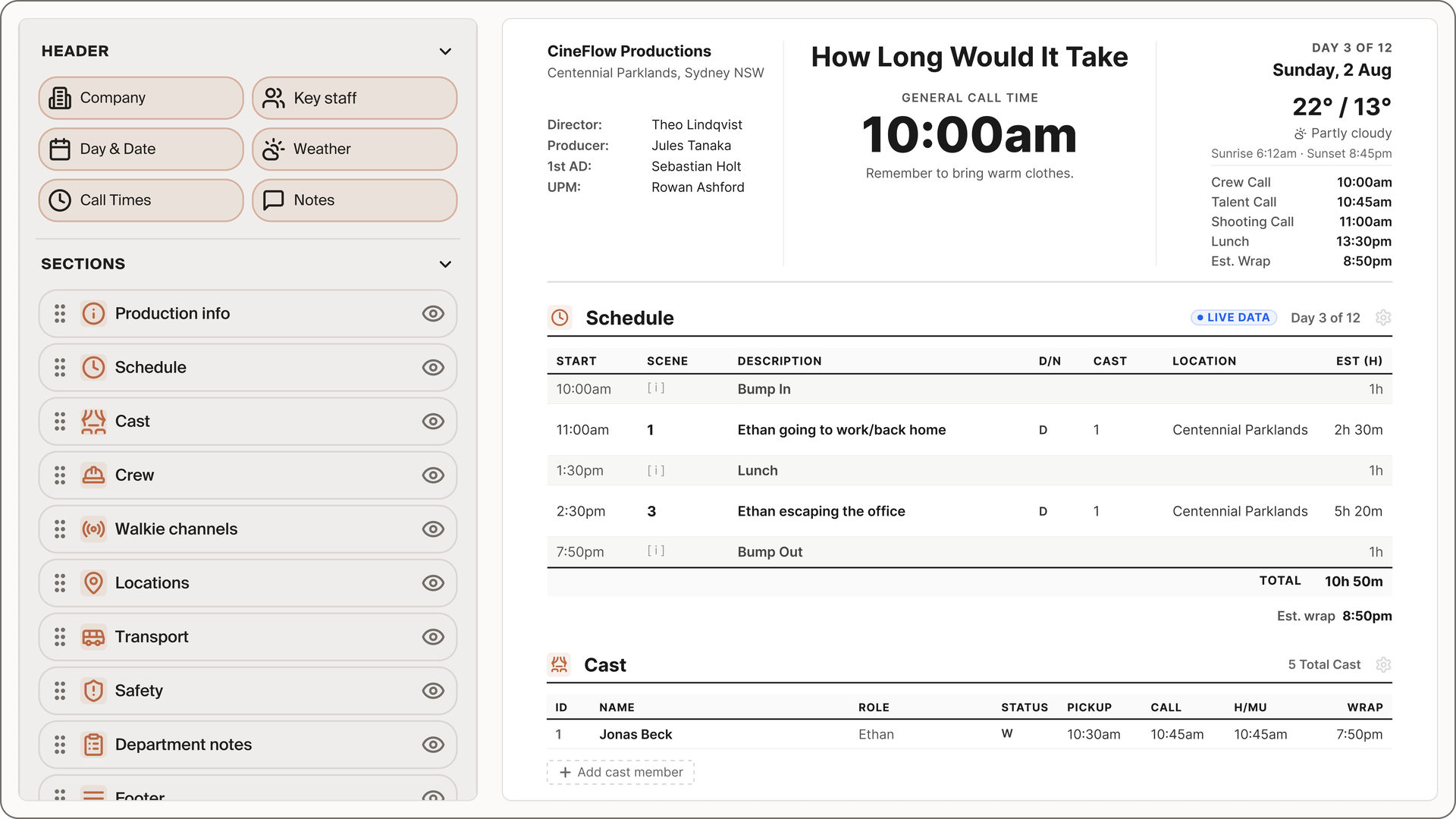
This is also where a connected system starts to pay off. When the schedule is built on the same surface as the breakdown and the shot list, the constraints arrive on their own. The scenes carry their cast and locations with them. Assign a scene to a day and the people that scene needs are gathered into that day automatically, which means the schedule can hand the day straight to the call sheet without anyone retyping a single name.
CineFlow is the creative space where filmmakers develop ideas into films, together. The schedule is not a spreadsheet living apart from the rest of the film. It pulls the cast and crew from the shots and scenes you assign, and it fills the call sheets from the days you build, so one change moves through everything it touches instead of stopping in a file on your desktop.
Build in room to recover
Every schedule breaks. An actor gets sick, a location floods, a scene takes three times as long as you thought. The goal is not a schedule that never breaks. It is a schedule that can absorb a bad day without collapsing.
Resilience comes from a little slack and a lot of clarity. Leave a contingency day where you can. Keep a few scenes movable so a day that falls behind has somewhere to shed weight. And keep everyone on the current version, because most schedule disasters are not the change itself but the half of the crew who never heard about it. When the script or the plan changes, the schedule should update and carry the change outward on its own. If you are still weighing up collaborative film scheduling tools, that is the test to run before you commit.
So group by location, cluster by cast, protect the light and the continuity, and build from the breakdown rather than the script. Leave room to recover, and keep the schedule connected to the days it feeds. The schedule that gets a film made is not the tightest one. It is the one that stayed true as the shoot met reality, and still got everyone to the right place at the right hour.