
Collaborative film scheduling tools are not just calendars with comments. A film schedule decides where people, light, locations, vehicles, costumes, and patience all meet. Collaboration means a producer can move scene 14, the first AD can see the cast conflict, and the crew opens one current call sheet.
This guide is for the person responsible for that schedule. If you are comparing tools, do not ask which one makes a schedule fastest. Ask which one keeps the schedule true after the first change.
What collaboration means in a schedule
A schedule is a promise built from dependencies. Scene 8 needs two actors, one car, a prop that has to survive from scene 3, and a location that is only free after four. Move the scene and the promise moves with it.
Collaboration means more than five people opening the same file. It means the producer, the AD, the cinematographer, the location manager, and the crew can each see the part of the plan they are responsible for. It means the right people can change the plan, and everyone else can trust what they are looking at.
A schedule that five people can edit but nobody trusts is not collaborative. It is just fragile.
The difference between sharing and collaborating
Sharing sends a copy. Collaborating works from the source.
A PDF is a photograph of a schedule. It was true when it was exported. A spreadsheet attachment is the same. The moment someone changes the master plan, every copy becomes a small risk. One person prints version two. Another reads version three. A driver follows the address from version one.
A collaborative schedule stays live. The person making the change and the person affected by the change are looking at the same thing. There is no file to resend and no old copy waiting in an inbox. That is the difference that matters at six in the morning.
What the tool has to keep connected
A shooting schedule is not a list of dates. It is the meeting point for the rest of the production. The tool you choose should understand what each scene brings with it.
- The scene and script version. The schedule should know which scenes exist and which revision they belong to.
- The breakdown. Cast, locations, props, costumes, vehicles, and special notes should arrive from the script breakdown, not from memory.
- The shot list. The scenes scheduled for a day should still know the coverage they need from the shot list.
- Cast and crew. The people attached to a scene should follow it when the scene moves.
- Locations and daylight. Interior or exterior, day or night, address, access, and the light available should stay close to the plan.
- The call sheet. The day should flow into the call sheet without being retyped.
The more of this the schedule already knows, the less the team has to carry in their heads.
The roles a schedule has to serve
Different people read the same schedule for different reasons.
The producer is reading for days, cost, and risk. The first AD is reading for order, coverage, and time. The cinematographer is reading for light and company moves. The location manager is reading for access, parking, and rules. The cast is reading for their own call. A department head is reading for the scenes that ask something of their department.
Good collaborative film scheduling tools let those people affect what they own and see what concerns them. The AD should not have to wait for a producer to unlock every change. A background artist should not be able to move a scene. A gaffer does not need every private casting note, but they do need to know that scene 12 became a night exterior.
This is why permissions matter. Collaboration without roles becomes noise. Roles without collaboration become gatekeeping. The tool has to hold both.
The questions to ask before you commit
A product page will tell you what the tool can do. These questions tell you how it will behave on a real shoot.
- Can more than one person work in the schedule at the same time?
- Can I control who can edit, who can comment, and who can only view?
- When a scene moves, do its cast, crew, elements, and notes move with it?
- Does the schedule stay connected to the breakdown and the shot list?
- Can the schedule fill the call sheet without another round of copying?
- Can I share one live link with the crew?
- Can I export the current version to paper for the floor?
- Can someone understand the day in ten seconds without a tour of the software?
- Can I see the impact of a change before the whole crew receives it?
- Will the tool still feel clear when the production grows from 3 scenes to 30?
The last question matters. A schedule that feels elegant with six strips can become unreadable with sixty. Test the shape of your real film, not the shape of the demo.
Test it with a change, not a demo
Every scheduling tool looks calm when nothing moves. So make something move.
Build a small version of your shoot. Use three scenes, two actors, two locations, and one scene that cannot move. Put two scenes on day one and one on day two. Then change the plan.
Move one scene to the second day. Change one actor's call time. Add a prop to the scene. Swap an interior for an exterior. Now follow the ripple. Did the schedule flag the conflict? Did the right people see it? Did the call sheet update? Did the shot list stay attached to the scene? Did you have to explain the change in a separate message because the tool could not show it?
A good tool makes change boring. The plan updates, the affected people see it, and the current version stays current. A weak tool turns one change into a small communications campaign.
Where CineFlow fits
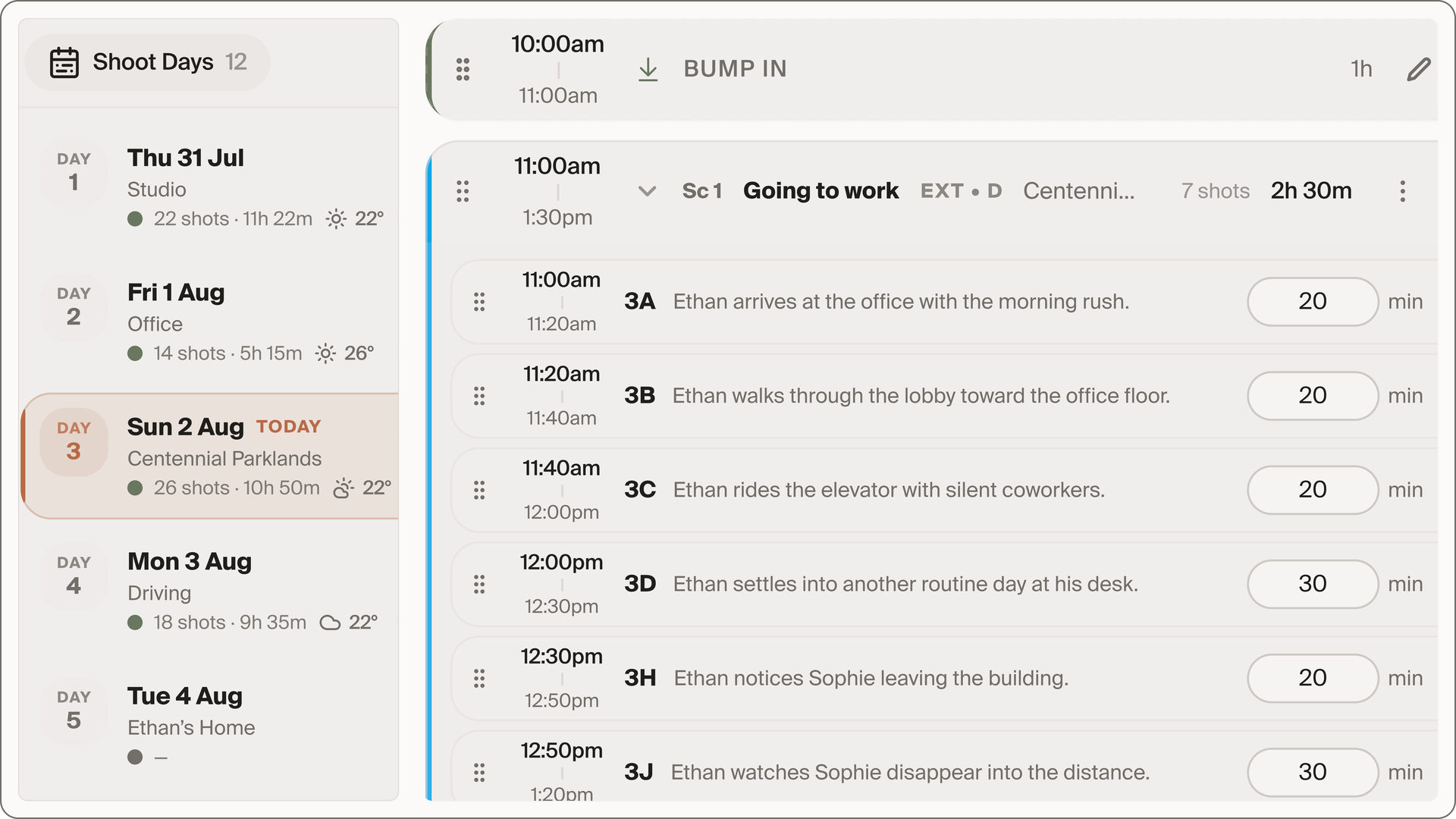
CineFlow is the creative space where filmmakers develop ideas into films, together. The schedule lives beside the script, the breakdown, the shot list, and the call sheet, so the plan does not have to be rebuilt in a separate tool when it is time to shoot.
The team can work in real time, with role based access for the people shaping the plan. A live link keeps the crew on the current version, and the day can still be exported to paper for the floor. When the script changes, the schedule is not left behind as a file that somebody meant to update. It is part of the same connected production, which is what keeps the crew in sync when the script changes.
If you are choosing between collaborative film scheduling tools, run the change test. Build the day, move the scene, and watch what follows.
The schedule that stays current
The right collaborative film scheduling tool does not just help you arrange scenes. It helps the whole production absorb change without splitting into versions.
Choose the tool that keeps the schedule connected to the work that created it. Choose the one that gives each role the right amount of control. Choose the one that still tells the truth after the location falls through, the actor's flight moves, and the night scene becomes a dawn. That is the schedule your crew can build a day around.