
The script changes. It changes in prep, it changes the night before a shoot day, it changes on set with the crew already standing by. A line, a prop, a whole new scene, a character cut. Script changes are not a failure of planning. They are planning. The thing that separates a change that improves the film from a change that derails the day is not how big it is. It is whether everyone ends up working from the same version. This is how to keep your crew in sync when the script moves.
The change is never just the change
The first rule of a script change is that a change is never only what it looks like. A new scene is not just a scene. It is a new location to find, a cast member to call, props and costumes to source, a setup to light, and time to be found in a day that was already full. A cut character is not just a name removed. It is a booking to release, a costume to return, a prop that leaves three other scenes, and a schedule that now has a gap in it.
Every change sends a ripple through the whole production. The ripple is the real event, not the edit to the page. And the ripple touches departments that were nowhere near the room where the change was made. That is why the danger is not the rewrite. It is the half of the crew who never learn that the rewrite happened.
Why stale versions are the actual problem
Picture the ordinary way this goes. A scene changes. Someone updates the script. Then someone has to remember to update the breakdown, and then the schedule, and then the shot list, and then regenerate the call sheet, and then email all of it to everyone affected, and then hope everyone opens the new files instead of the old ones.
Every step in that chain is a place for the change to stall. One document gets updated and another does not. One person is working from the new schedule and another is still on last week's. Nobody did anything wrong, and yet the camera team is prepping a shot that was cut and an actor is driving to a call time that moved. The change was fine. The stale version is what broke the day.
See the impact before you commit
The wisdom the old process was built around is worth keeping. Never make a change without seeing what it touches. A new scene that needs a location you do not have, or an actor who is already released, is not a small change. It is a problem wearing the clothes of a small change, and you want to know that before you say yes, not after.
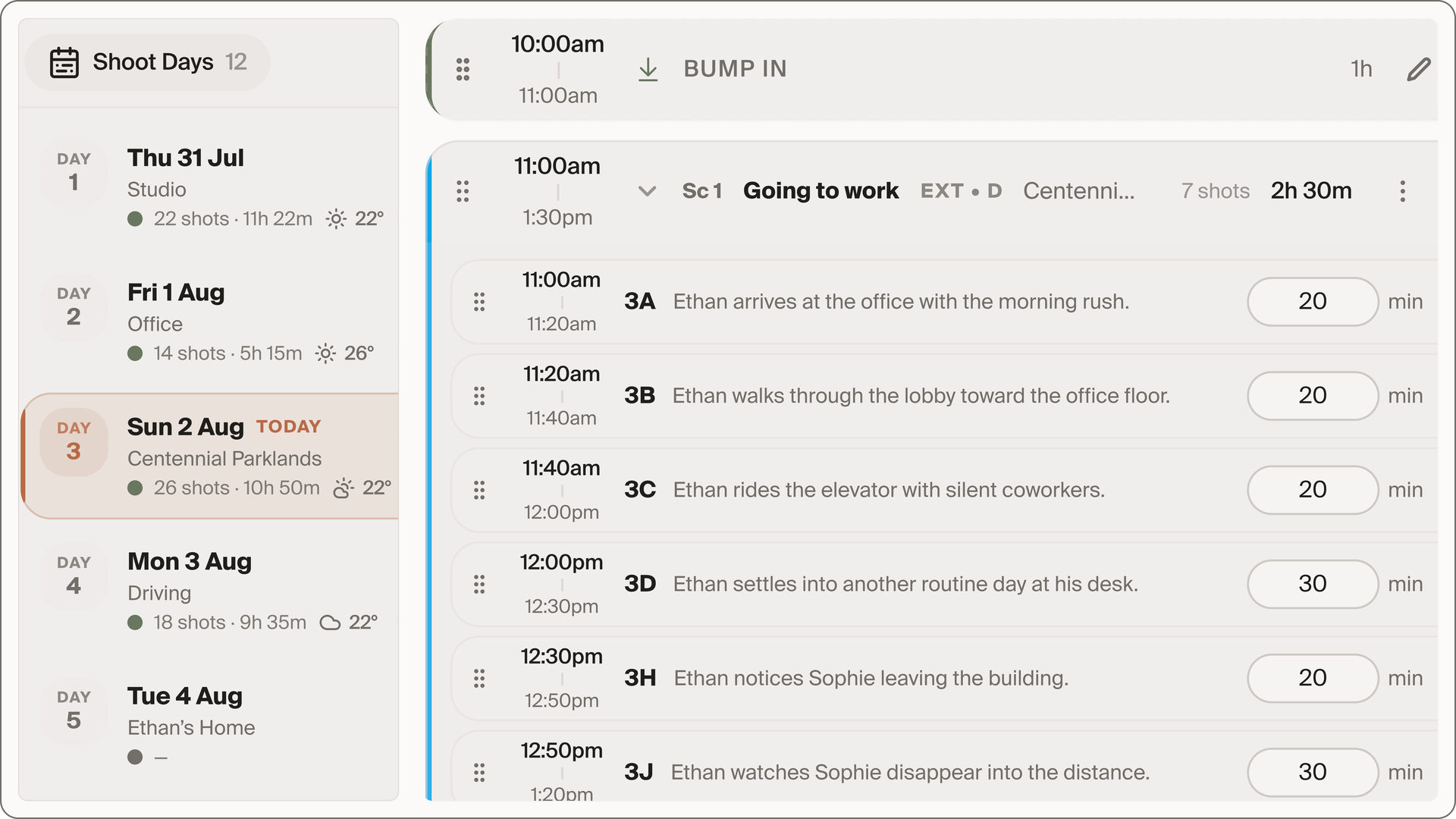
So the question to ask of any revision is what does this touch. Which days does it move, which cast does it add or free, which props and locations come and go, which call times shift. On a connected production that impact is something you can see rather than something you have to convene a meeting to work out. You make the change against the plan and watch what lights up, and then you decide with the whole cost in view.
Let the change carry itself
The better answer to the ripple is not a faster chain of manual updates. It is to stop having a chain at all. When the script, the breakdown, the schedule, the shot list, and the call sheet are connected, a change made in one reaches the others on its own. Cut a scene and its shots leave the shot list and its day reopens in the schedule. Add a character and the scenes they are in start asking for them, and the call sheets for those days pick them up. You change the film once, in one place, and the production updates around it.
CineFlow is the creative space where filmmakers develop ideas into films, together. This is the part of that idea that shows up most on a hard day. There is one version of the film, held in common. When it changes, it changes for everyone at once, because there is no second copy to fall behind. The energy you would have spent chasing documents goes back into the actual decision.
Keeping the people in sync, not just the files
Connected documents solve half of it. The other half is the people, and people need to know a change happened, not just have it silently appear. Keeping a crew in sync means the current plan is always one link away, so nobody is ever working from a printout that froze two revisions ago, and it means the people affected by a change can tell that something moved and see what it was.
That is the difference between a change that spreads calm and a change that spreads panic. Panic comes from uncertainty, from not knowing whether the sheet in your hand is real. Calm comes from a single current source everyone trusts. When the plan is connected and the current version is always the one people are looking at, a late change stops being a crisis and becomes a small, visible adjustment that the production absorbs and moves on from.
The whole film in one moving piece
Staying in sync through changes is really an argument for keeping the whole film in one connected place. A change is only dangerous when the pieces of the film live apart, in a script here, a schedule there, call sheets in an inbox, notes in a chat, each one updated by hand and out of step with the rest. Bring them onto one surface and a change has nowhere to get lost.
So treat every script change as a ripple, not a line edit. Look at what it touches before you commit, let the change carry itself through the connected plan instead of retyping it into four documents, and keep the current version one link from everyone. The films that survive last minute changes are not the ones that never change. They are the ones where the whole crew was always looking at the same film.